
Export for Translation
Applies to: viflow (subscription) | Article: 1590705 | Updated on 21.07.2026
{{gold}}This function is available in the viflow subscription gold edition (not in viflow blue and silver).{{gold}}
For a faster translation you can translate all (!) contents of the process model in a table and import them afterwards.
This procedure is recommended if, for example, an external translation agency is commissioned with the translations.
In the first step, the table for the translation must be created or exported:
- On the Data tab, click the Export button in the Translations group.
 There are three options to choose from:
A. All Objects
All objects in the process model are exported.
B. Selection
Only the process selected in the Process Structure window is exported.
C. Selection incl. sub-graphics
The process selected in the Process Structure window, including all subprocesses, is exported.
Click one of the three options, and the Save As window will open.
- Enter a file name here and select a directory in which the Excel spreadsheet is to be created.
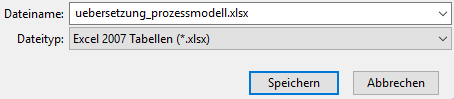
- Click Save.
The Excel table is created and (if the Excel program is installed) opened directly in Microsoft Excel.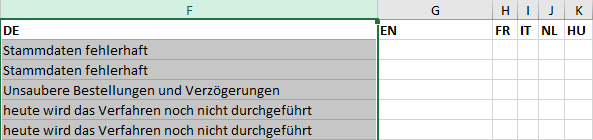 The table shows the content of the first language (here: "German" in column "F"). For each content language created, an additional column is created with the international abbreviation of the respective language.
 - Start translating now by entering the texts in the other language into the respective cells.
- After one or more languages have been completely translated, the table can be imported again and the translation transferred to the process model.
You can find out how to import the table with the translation again in the ››› How to import tables for the translation chapter.
